Victoria Chemicals PLC (B): The Merseyside and Rotterdam Projects - Case Solution
This Victoria Chemicals PLC (B): The Merseyside and Rotterdam Projects case study is part of a series of cases. This case study deals with a project review of a planned improvement of a polypropylene production plant. The executives of the company must decide on either mutually exclusive projects.
Case questions answered:
- How do the two projects (Merseyside and Rotterdam) compare on the basis of Victoria Chemicals PLC's investment criteria? What might account for the differences in rankings? Are they mutually exclusive?
- Is it possible to quantify the value of potentially adding Japanese technology to the Merseyside project? How, if at all, does this flexibility affect the economic attractiveness of the project?
- Which project should James Fawn propose to the chief executive officer and the board of directors?
- Why are the Merseyside and Rotterdam projects mutually exclusive?
- How do the two projects compare on the basis of Victoria Chemicals’ investment criteria? What might account for the differences in rankings?
- Is it possible to quantify the value of potentially adding Japanese technology to the Merseyside project? How, if at all, does this flexibility affect the economic attractiveness of the project?
- What are the differences in the ways Elizabeth Eustace and Lucy Morris have advocated for their respective projects? How might those differences in style have affected the outcome of the decision?
- Which project should James Fawn propose to the chief executive officer and the board of directors?
Victoria Chemicals PLC (B): The Merseyside and Rotterdam Projects Case Answers
 This case solution includes an Excel file with calculations.
You will receive access to two case study solutions! The second is not yet visible in the preview.
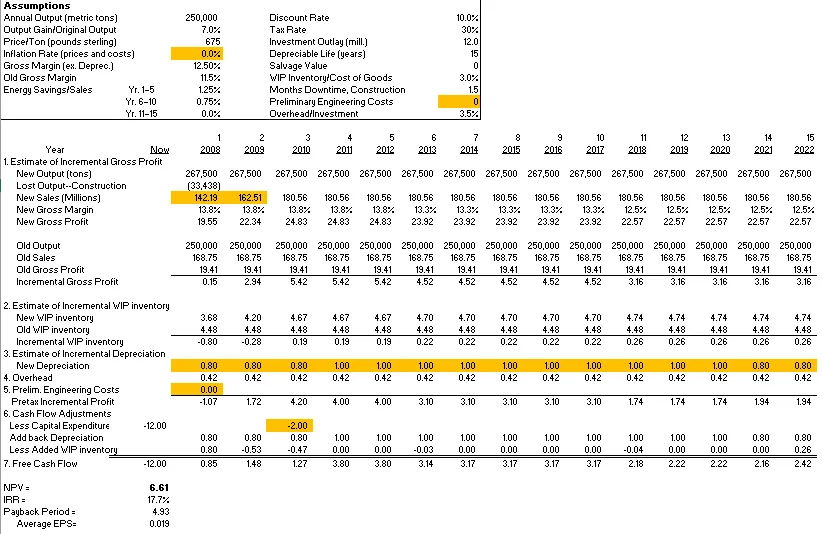
1. How do the two projects (Merseyside and Rotterdam) compare on the basis of Victoria Chemicals PLCs' investment criteria? What might account for the differences in rankings? Are they mutually exclusive?
In Victoria Chemicals PLC (A), I changed the inflation rate to 3%. However, I noticed that in the Rotterdam Project analysis, the inflation rate was 0% while the discount rate remained at 10%.
To remain consistent, I changed my inflation rate back to zero. By doing this, my NPV, IRR, and EPS went down. The payback period would actually be 5.26, which went up (I screenshotted my graph before I calculated the payback period). So, the payback period also went up.
One thing that accounts for the differences in ranking done by Victoria Chemicals PLC would be the fact that the Rotterdam project slowly increases new output rather than having the new output maxed out in year one.
The construction downtime is another factor that accounts for the differences in ranking. The Merseyside project accounts for 1.5 months of construction, while the Rotterdam project accounts for many months over 3 different years of construction.
As far as mutual exclusivity, this question is a bit complicated. It seems that if the Rotterdam project is chosen, then the Merseyside project could not be chosen (making them mutually exclusive).
However, if Victoria Chemicals PLC chooses the Merseyside project, there is an opportunity to implement the technology from the Rotterdam project in the future (making them not mutually exclusive). So I would say both yes and no.
Unlock Case Solution Now!
Get instant access to this case solution with a simple, one-time payment ($24.90).
After purchase:
- Solution files delivered straight to your inbox.
- Secure checkout — no account required.
Best decision to get my homework done faster!
Michael
MBA student, Boston
FAQ
How do I get access?
Upon purchase, you are forwarded to the full solution and also receive access via email.
Is it safe to pay?
Yes! We use secure payment providers to process your transaction safely.
What is Casehero?
We are the marketplace for case solutions - created by students, for students.